“The Triumph of Human Innovation”
“Can you tell me about a time that you innovated?”
I was caught pants-down in a job interview with that question early in my career. It was the perfect “gotcha”…obvious enough that my mouth immediately opened to respond, but with a layered complexity that caused me to stammer when I realized I wasn’t prepared.
I didn’t get the job. But that question sat with me for over a decade. What actually is innovation? How do I…well…”do” innovation?
For practical purposes, the definition I’ve adopted for this grandiose-sounding word is pretty trivial: Innovation is a non-obvious solution to a problem.
By this definition, an innovation doesn’t need to change the world. It just needs to solve something for someone, in a way that nobody else has thought to try.
For fifteen years, this earworm has squatted in the back of my brain, staying present but delicately aging. And then AI came along, and it sprang back to life.
Because as much as AI accelerates our ability to do anything that doesn’t require new thinking, it seems to inhibit our need, willingness, and perhaps even our ability to do any new thinking at all. For good reason: the collective knowledge amassed by the 10 billion humans alive during the modern era is staggering, and the nebulous neural network that contains it all has a lot of great solutions to a lot of daily problems.
By handing that tool to our children, we’re enabling them to accomplish things more quickly and independently than ever before. But are we also robbing them of the desire—and ability—to innovate? How can we flip the script on how we teach our kids and make innovation a learned skill, so they can do the work that AI can’t?
And if our kids were armed with an “innovation superpower,” could they create even better than adults? “The best children’s book in the world,” perhaps?
This was the question at the heart of the conversation when my own middle school teacher, Laura Miller, reached out to connect about my new picture book series Younger Me Academy. I had created Younger Me Academy to help children and grownups build the kind of superpowers that help them stay above the fray in a rapidly-changing world: critical thinking, problem-solving, social awareness, and executive functioning.
Mrs. Miller and I embarked together on a year-long journey to run a complete innovation lab for her sixth graders, with the stated outcome of creating “the best children’s book in the world.”
I brought the science and psychology behind the Younger Me Academy series, and Mrs. Miller brought the classroom mastery you can only build from decades of selflessly and indignantly defying norms fueled by pure care for students. Seriously—she’s a firecracker that only aims true north.
Here’s how we pitted twenty-eight middle schoolers against the algorithm of predictable thinking:
BEING WRONG TO BE RIGHT
Most people think that the best way to build confidence is to build competence. In reality, this is a pretty fragile form of confidence. It works beautifully…until you’re threatened by a new kind of problem, more skilled competition, or even a simple absence of validation that causes you to doubt yourself.
A far more robust form of confidence is simply to become more comfortable with being wrong—and to actually build “being wrong” into your innovation process.
That’s how the the Scientific Method works, and it’s one of the most powerful tools we have to overcome the subtle biases that keep our brains from being truly creative. After all, you can’t discover a non-obvious solution without being willing to discover that your obvious solution wasn’t right.
So when our students developed an idea or a manuscript, we taught them to treat it like a crash test dummy rather than a fragile baby, and actively look for ways to break it. We rewarded them for finding the flaws and helped them get comfortable with being “wrong” over and over again as each draft led them closer to “right.”
CREATING CREATIVITY
We tend to think of our creative heroes (Beethoven, Edison, etc.) as geniuses who possess extraordinary instinct, talent, or expertise that helps them pluck great ideas from thin air.
But the reality is often less magical. The greatest ideas don’t start on a pedestal—they start as a needle under a haystack of weaker ones.
Geniuses don’t necessarily have fewer bad ideas, but they almost always create more ideas—enough that a few amazing ones eventually materialize under the pile. Edison created thousands of inventions to create the two that we all know; Beethoven developed hundreds of symphonies to land a handful among the greatest compositions of all time.
So we followed their lead. Working independently, our students used rounds of idea-generating prompts to brainstorm a haystack of hundreds of ideas before sharing a single one with the class (sharing too early influences thinking and limits variety). Once our 6th grade idea factory built its haystack, we shoveled out the “hay” using friendly tournaments until we revealed the “needles” underneath. Only then did the writing begin.
THE POWER OF “ALMOST PERFECT”
“Perfect” sounds incredible until you read the studies showing how the ever-higher standards we hold our kids to are challenging mental health. And in the world of innovation, perfectionism is nothing but a mask to hide the fear of being judged, standing between us and a world of would-be masterpieces.
We fought this by teaching our students that “almost perfect” done right is far easier, faster, and often quite sufficient. The trick is to deeply understand your objective, focus on the few things that matter most to achieving it, and the hard part: deprioritize the rest.
So our students didn’t let “perfect” get in the way of “good enough.”
Before they even picked up a pen, they ran a reverse experiment to identify the 3-4 features of a book that were most important for their readers, then tested dozens of hastily-written synopses and manuscripts to make sure the “needles” we were finding in our haystack were strong enough to hold up to the effort needed to weave a complete masterpiece.
They saved the painstaking perfection for where it really matters: the final draft of manuscripts they already knew would be winners.
BUILDING RESILIENCE THROUGH FAILURE
Most people think of “resilience” as the ability to rise to big challenges and persevere. In reality, Hiccup (the hero of How To Train Your Dragon) had it right: it’s usually easier to befriend the beast than to slay it.
We encouraged our students to embrace a growth mindset: the idea that being bad at something today doesn’t have to mean you’ll be bad at it tomorrow, and the act of embracing “failure” as a necessary—and even fulfilling—step on the way to success.
It’s the difference between “my manuscript isn’t great” and “my manuscript isn’t great…yet.” One sees the barrier as the end of the road, and the other sees it as a place to sit and reflect before continuing the journey.
Innovation requires an almost absurd willingness to be wrong in public, which kids (and adults!) are not naturally great at. So we made a poster to celebrate “Fearless Failure Heroes,” and structured our feedback sessions in a way that they learned to expect constructive criticism.
Then, we taught them to deliver and receive that feedback in ways that help them put down their inner shields and let the dragon get close enough for a belly rub.
TEAMWORK MAKES THE DREAM WORK (when done properly!)
Creative success is not a solo sport. You need feedback. You need refinement. And most importantly, you need advocacy—people to see enough potential in your idea to get it off the shelf and into the world.
But balancing teamwork and independence requires walking a tightrope of cross-disciplinary psychology. Team up too early, and people converge on the first decent idea. Give an individual too much ownership, and they may not help their peers succeed. Encourage them to “grow the pie” without letting them take a big enough slice, and they won’t be as selfless next time.
So we walked the tightrope:
- Ideation vs. Refinement: Our students generated ideas independently, and refined them together (because nobody can see the flaws in their own baby)!
- Generosity vs. Self-Interest: They identified their own strengths and weaknesses, so they knew when to ask for help vs. lend their skills to others.
- Ownership vs. Motivation: They “owned” their ideas and early synopses, but only until they were partially developed. Then they worked in teams that allowed others to carry them forward in different directions to challenge, reshape, and share ownership of the work.
- Competition vs. Collaboration: We balanced camaraderie with competition by ensuring students were teaming up for their work, but with a competitive edge through cross-class tournaments.
In other words, we didn’t just teach them how to work together. We also taught them when not to.
The Triumph of Human Innovation
One of my favorite outcomes of this project was the new book, I AM KING CHAMELEON! I DEMAND TO BE SEEN! If you picked up the book without reading this article, you’d probably never notice these principles sprinkled throughout as you search for that arrogant lizard.
But just like a chameleon, they are camouflaged in the story. King Chameleon begins by demanding an immediate solution to his camouflage problem:
I am a KING! But how can I command a king’s respect…
When COLOR-CHANGING SKIN makes me so tricky to detect?!
No matter how loudly he bellows, there is no easy answer. He tries and fails until he finally humbles himself and perseveres through the haystack of his bad ideas until he’s neck-deep in mud.
Only then does he realize that the solution wasn’t the only thing hidden—the problem itself was unclear. He didn’t need to become more visible; he needed to become more comfortable in his color-changing skin and learn the value of collaboration and friendship:
“I guess, though I’m invisible, I’m happy to be me.
I’m not your KING chameleon…just a friend that you can’t see.”
That’s a pretty good metaphor for innovation, since the breakthrough isn’t always just a better answer. Sometimes it’s a better question.
That’s where the AI parallel gets interesting. AI models can create polished rhymes, generate structure, and produce in an instant what would take humans hours. But the universal rule with AI is “Garbage In, Garbage Out.”
AI can’t produce anything worth using without a human to ask the right question. A human who, like King Chameleon, has rolled in the muddy mess long enough to rule out the wrong ones. Someone who has experienced the vulnerability of middle school, felt the embarrassment of a terrible idea, or felt the unbridled joy and relief of a long-awaited breakthrough.
And AI certainly can’t replace the deep bond that only a teacher like Mrs. Miller can create with her students—one that, 25 years after leaving her classroom, led us to a messy, human experience that created a solution to an AI-generated problem we didn’t even know existed yet. One that hopefully changed the lives of 28 students who are now better prepared to fail fearlessly, think non-obviously, and innovate.
It definitely changed my life too. After all, the next time someone asks me to “tell me about a time that you innovated,” I now have an answer:
“I helped create the ‘best’ children’s book in the world.”
It’s certainly up there—at least in my book (pun intended). I hope you think so, too!
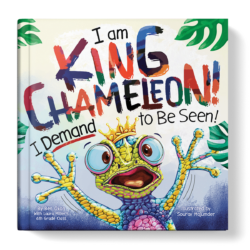
I Am King Chameleon: I Demand to be Seen!
Author: Ben Okon
Illustrator: Sourav Majumder
Published September 8th, 2026 by Sourcebooks Wonderland
About the Book: From award-winning author Ben Okon comes a hilarious seek-and-find picture book. Can YOU spot this chameleon playing hide-and-seek?
King Chameleon isn’t just loud, proud, and impossible to ignore—he’s THE KING, and he won’t let you forget it! From outrageous rhymes to spot-the-chameleon surprises, I Am King Chameleon! I Demand to be Seen! is the ultimate laugh-out-loud picture book for kids who can’t resist shouting along, spotting the camouflaged lizard on every page, and laughing at his ridiculous demands.
I am KING CHAMELEON!
I demand to be seen!
You can’t ignore ME…
I’m the star of the scene!
Part activity book, part silly story, and all FUN, this read-aloud is perfect for:
- Kids ages 4-8 who love to laugh.
- Fans of color, chaos, and comedy
- Parents, educators, and reluctant readers who love humor, vibrant illustrations, and interactive storytelling.
- Birthday gifts, classroom fun, storytime giggles, and bedtime belly laughs.
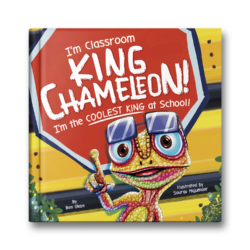
I’m Classroom King Chameleon: I’m the Coolest King at School!
Author: Ben Okon
Illustrator: Sourav Majumder
Publishing December 8th, 2026 by Sourcebooks Wonderland
About the Book: King Chameleon is too cool for school… or so he thinks. From bestselling author Ben Okon comes this hilarious seek-and-find picture book perfect for kids 4-8!
King Chameleon is back—and this time he’s taking over the classroom! From math class to the soccer field to the school play, King Chameleon is determined to show the whole school that he is SO cool. His outrageous, over-the-top personality and “cool” talents turn every minute of the school day into laugh-out-loud classroom chaos.
Packed with silly rhymes, comedic confidence, and hidden chameleons to spot, I’m Classroom King Chameleon! I’m the Coolest King at School! is a wildly funny interactive picture book for kids, parents, and educators alike. This back-to-school book is perfect for first day of school gifts, classroom read-alouds, bedtime giggles, and fans of funny animal characters. Can YOU find this cool chameleon playing hide and seek?
“I’m Cooler King Chameleon, and I’ll come with you to school.
I bet that you’ll be glad to have a friend who’s CRAZY cool!”
About the Author: Ben Okon is the award-winning author of dozens of children’s books including the new “I AM KING CHAMELEON! I DEMAND TO BE SEEN!” a collaboration created from an innovation lab built with Mrs. Laura Miller for her 6th-grade class at BCHA. Ben is also a strategist with experience at companies like Google and Bain & Co. and holds an M.B.A in Entrepreneurship from the Wharton School of Business and a B.S. in Hotel Administration from Cornell University.
Thank you, Ben, for this aweseom call for using the human mind!








 and
and